Inked in Red and Black: A Tattoo Artist's Tour of Flamurtari Iconography
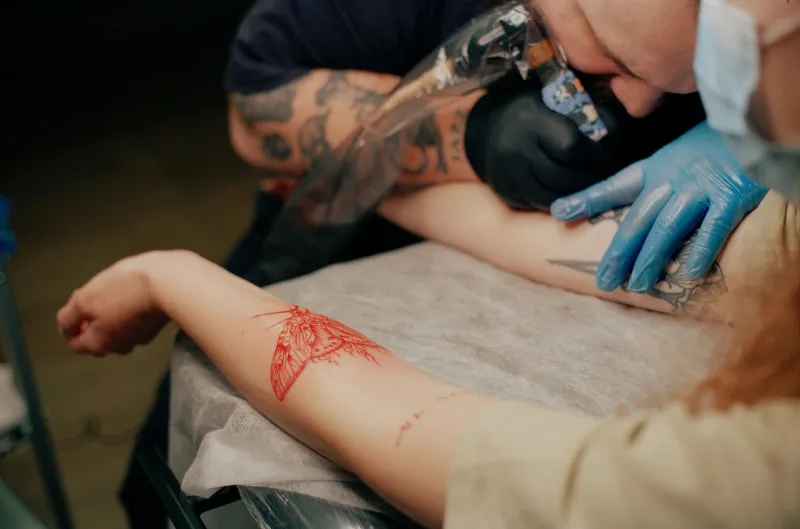
There's a moment every tattoo artist learns to recognize. Someone sits down, flips through flash sheets, hesitates over the usual anchors and roses, and then quietly asks: "Can you do a flaming torch?"
If you work anywhere near an Albanian-American community — Boston, New York, Detroit, the Tampa suburbs — you've probably inked one by now. And if the client cried a little when you finished? Almost certainly a Flamurtari fan.
We spoke with Arben K., a tattoo artist based in Queens who grew up going to matches at the Flamurtari Stadium before his family emigrated, and who estimates he's done two dozen club-themed pieces in the last five years. "American fans get logos tattooed all the time," he told us. "But Flamurtari ink hits different. It's never just a logo. It's a whole family story in one sitting."
Here's his breakdown of the five designs that keep coming up — and what they actually mean.
The Flaming Torch
The centerpiece of the crest and the most requested design by a mile. Arben explains that placement matters more than people think. "The torch on the forearm says, 'I carry this every day.' On the chest, over the heart? That's the full commitment. I've had guys fly in from Chicago for a chest piece."
He recommends keeping the flame slightly oversized relative to the torch itself. "The flame is the point. Vlorë is the city where Albanian independence was declared. The fire isn't decoration — it's history."
The 1987 Date
Ask any old-school supporter about the greatest nights in club history and they'll start talking about the late '80s European runs, when Flamurtari pushed giants and made Vlorë shake. The date — or simply "87" in bold numerals — has become shorthand among diaspora fans for everything the club once was and could be again.
One client, a second-generation fan from Massachusetts, told Arben the number stood for "proof that we belonged on the big stage." Arben's advice: pair the numerals with a small laurel or the stadium silhouette so the reference reads clearly to non-fans.
The Red and Black Split
Simple, striking, and increasingly popular with younger fans who want something subtle enough for a corporate job. Half red, half black, split diagonally across the inner wrist or behind the ear.
"It's the entry-level piece," Arben laughs. "But honestly? Some of the cleanest work I've done. Two colors, no lettering, and every Albanian who sees it knows exactly what you are."
The Stadium Skyline
The Flamurtari Stadium, wedged against the hills above the Ionian coast, is one of the most scenically located grounds in Europe — and it translates beautifully into linework. Arben has done the stadium's distinctive outline in fine-line blackwork more times than he can count, often with the date of a client's first visit underneath.
"This is the design for the pilgrims," he says. "The fans who actually made the trip back. Nobody gets the stadium tattooed without standing in those stands first."
The Eagle and the Torch Combined
The most ambitious option: the double-headed eagle of the Albanian flag woven around the club torch. It's a statement piece, usually a half-sleeve, and Arben treats it as a commission rather than a flash design.
"You're telling two stories at once — country and club, and the way they blur together in Vlorë. It takes multiple sessions. It's not for the faint of heart or the faint of wallet."
More Than Skin Deep
What strikes Arben most isn't the designs themselves — it's who's asking for them. "Half my Flamurtari clients were born here. They learned about the club from their fathers, their gjysh, old YouTube clips. The tattoo is how they say, 'I'm part of this too.'"
Thinking about joining them? Arben's one rule: don't get the ink before you've sung in the stands at least once. "The torch means more after you've heard three thousand people scream it into a Vlorë night."
Wise words. But if you've already been — you know exactly which design is calling your name.